


For many Indian families, software was a reliable story. Study engineering, learn to code, get a campus job, and begin a life with more options than your parents had. That story changed lives. It is understandable that parents still want it for their children.
But a student entering college in 2026 is entering a different market from the one that rewarded graduates 20 years ago. The old promise—that a degree, a short course, and basic programming skills will predictably lead to an IT job—has weakened. That is the job I mean when I say the “software developer job is gone.” Software engineering itself is very much alive.
This distinction matters. Panic can push a student into the next fashionable course. Complacency can cost them four years and a great deal of family money. Neither helps.
Start with the numbers, and read them carefully
India's All India Survey on Higher Education (AISHE) 2023–24 reports 8,33,808 undergraduate pass-outs in Engineering & Technology (Table 36). That is higher than the often repeated estimate of five or six lakh. It includes engineering disciplines beyond computer science; it is not a count of students seeking software jobs. Students from BCA, MCA, science, commerce, and other routes also compete for some technology roles.
On the employer side, Nasscom's FY2025 estimate put net additions to India's technology workforce at 1,26,000, taking the workforce to about 5.8 million. Net additions are jobs added *after* departures; they are not the number of graduate hires. They also include experienced workers and functions beyond software development. Dividing 1,26,000 by 8,33,808 would not produce a placement rate. The two figures do show why a large graduating class cannot assume that industry growth will absorb everyone through a simple campus pipeline.
The global picture also resists easy slogans. The World Economic Forum's Future of Jobs Report 2025 lists software and application developers among fast growing roles, while employers expect 39% of workers' existing skill sets to change or become outdated by 2030. That is an employer survey and a forecast, not a guarantee of openings for Indian freshers. It says opportunity and disruption can arrive together.
Five years of fresher hiring: a boom, a correction, and a partial return
The large IT services firms helped build the campus-to-career route many families remember. Their disclosures show why one strong placement year is a poor basis for a four-year education decision. The figures below are *company-wide fresher hires*, not India-only campus placements or software-developer hires. Fiscal years end in March.
- FY2022: TCS hired more than 1,10,000 freshers; Infosys hired 84,782 fresh college graduates globally.
- FY2023: TCS hired more than 44,000; Infosys hired about 50,000 globally.
- FY2024: TCS did not give a comparable fresher total in its annual report; Infosys hired about 11,900 globally.
- FY2025: TCS hired 42,000; Infosys hired 15,288 globally.
- FY2026: TCS hired more than 44,000; Infosys hired more than 20,000 globally.
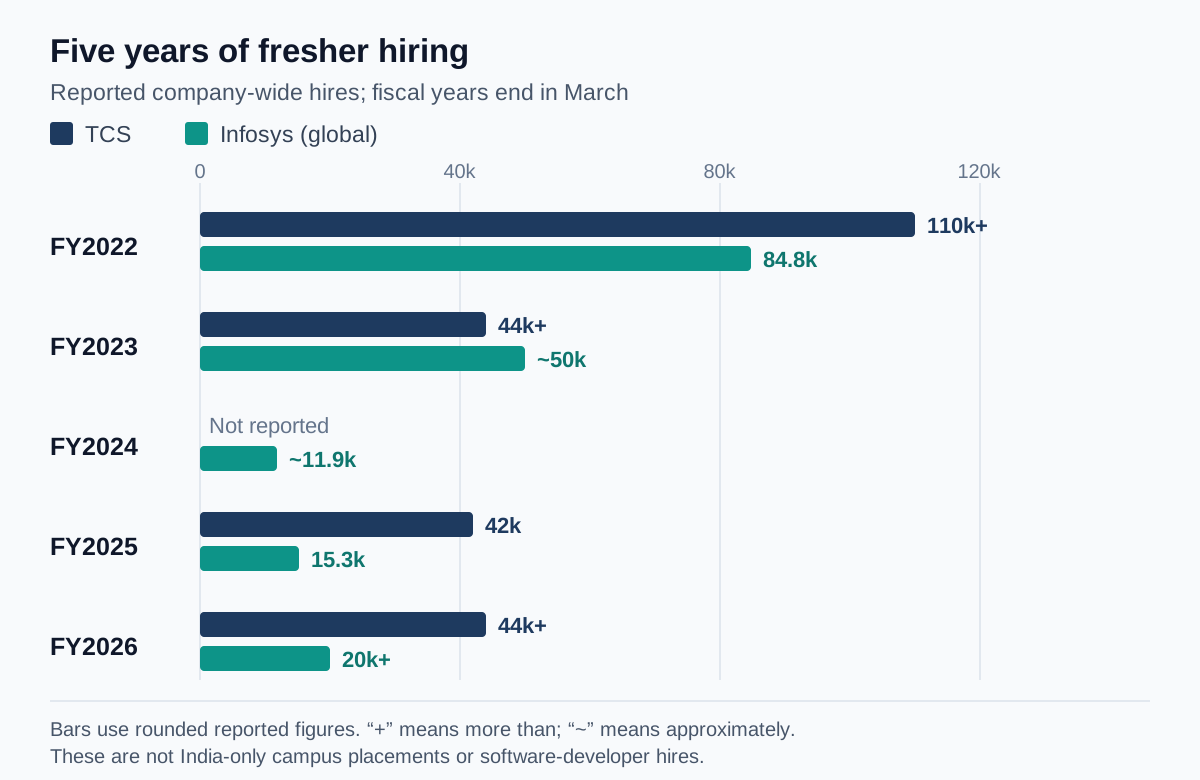
*Company-reported fresher intake, with rounded values where the reports use “more than” or “about.” The linked disclosures above give the underlying figures and scope.*
FY2022 was an exceptional hiring boom, followed by a steep correction. TCS's FY2026 report of more than 44,000 freshers contrasts with more than 1,10,000 in FY2022. Infosys had recovered from its FY2024 low but remained well below its FY2022 intake. The pattern also warns against declaring the market “dead”: TCS and Infosys still recruit tens of thousands of beginners. HCLTech added 7,829 freshers in FY2025, even while reporting a net headcount reduction partly affected by a divestiture. Hiring, joining, and net workforce growth are different measures.
This is an illustrative two-company timeline, not a total for the industry. It cannot isolate AI's effect from demand, attrition, or the post-pandemic hiring cycle. It does show that the old campus route is volatile, and that a family's plan needs more than the assumption that a large recruiter will visit next year.
What changed on the ground?
First, employers have more ways to produce routine code. In a 2025 study of 500,000 coding-related interactions, Anthropic classified 79% of interactions with its coding agent as automation. This measures use of one product, not jobs lost. My inference is that a portfolio made of tutorial clones and generated CRUD applications now tells an employer less than it once did. A working demo is easy to make; understanding, reliability, and ownership are harder to demonstrate.
Second, entry-level hiring is sensitive to business cycles. A company can continue to need software while pausing campus recruitment, hiring fewer people, delaying joining dates, or shifting work toward experienced teams and tools. AI is one pressure among several. It would be careless to blame every difficult placement season on AI alone.
Third, “an IT job” is not a single job. Development, quality engineering, infrastructure, cybersecurity, data work, implementation, operations, customer support, and business analysis require different strengths. Some have accessible entry points; others only appear accessible in course advertisements. The actual question is which problems an employer will trust a beginner to solve, under what supervision, and for what pay.
The information gap falls hardest on families with fewer connections
Some students hear about these changes from working engineers, internships, or alumni. Many do not. There is no reliable figure for how many students understand the shift, but access to current market information is clearly uneven. A student without an engineer in the family may never hear how hiring decisions are changing until placement season arrives.
Colleges have an incentive to fill seats and advertise placements. That does not mean every college hides bad news, but families should ask for evidence rather than rely on a placement headline. Parents outside technology may have built their advice from the successful careers they have seen over two or three decades. They are trying to help; the market they know may simply be gone. Families with less formal education, less English fluency, fewer industry contacts, or less money for experiments have even less room for a costly mistake. This is a problem of access to information, not a failure of ambition or intelligence.
Before paying for a degree or an additional course, ask the college for branch-wise, cohort-wise outcomes: how many students enrolled, how many graduated, how many received offers, how many actually joined, the median pay, the types of roles, and the names of employers. Speak directly with recent alumni. Treat “highest package” as an anecdote, not a prediction. Calculate the total cost, including fees, living expenses, travel, and any loan interest.
What a fresher should build now
The answer is not to abandon coding. It is to stop treating syntax as the whole profession.
- Learn the foundations well enough to detect mistakes. Pick one language and become comfortable with data structures, databases, HTTP, Linux, version control, testing, and basic security. Explain why a program works and where it will fail. AI tools make this more important because plausible output can conceal bad assumptions.
- Build one useful thing for a real user. A local business workflow, a college office process, a community group, or an open-source issue can be a better starting point than another clone. Record the problem, constraints, decisions, tests, deployment, feedback, and fixes. Protect people's data and get permission before using it.
- Use AI openly and verify its work. Ask an agent to explore options or draft code, then review the output, run tests, inspect security and failure cases, and document what you changed. Be able to rebuild or explain the critical parts without the agent. An employer should see evidence of judgment, not a claim that you wrote every line unaided.
- Explore adjacent roles through small experiments. Try a QA automation task, a support investigation, a data cleaning project, a deployment, or a security lab. Compare actual job descriptions and talk to people doing the work. Do not buy an expensive “AI,” “cloud,” or “cybersecurity” certification on the assumption that the label creates an entry-level vacancy.
- Practice communication and business context. Write a clear bug report, ask a user what outcome they need, explain a tradeoff, and present what you learned. These skills make technical work useful to a team.
- Search beyond campus placements, with care. Use company career pages, alumni, internships with real supervision, apprenticeships, and credible local employers. Check role terms, pay, joining date, and training fees. Never pay a recruiter for a promised job.
This is a portfolio of evidence, not a checklist of badges. A student who can show how they discovered a problem, built a small solution, used tools responsibly, and improved it after feedback has a more credible story than one with ten certificates and no work to discuss.
If software is not your path
The bigger mistake is treating “IT or failure” as the only choice. Global employer research from the World Economic Forum expects growth in care, education, delivery, construction, agriculture, and technology-related work. These are broad forecasts, not promises of good local jobs or pay. The same report says analytical thinking, resilience, leadership, and collaboration remain important alongside technical skills.
For a student considering either IT or another field, investigate a *role* rather than a fashionable sector. A useful comparison has six questions:
- Is there local demand? Read recent vacancies from real employers in two or three cities, including smaller firms. Separate entry-level posts from roles requiring three years of experience. Check the employer's own career page when possible.
- What is the actual work? Speak with someone doing the job. Ask about a normal week, shifts, field travel, customer contact, tools, supervision, and the hardest part. A title such as “analyst” can hide very different work.
- What is the legal or credential gate? Nursing, teaching, accounting, electrical work, and many other professions may require recognized degrees, registration, or licenses. Check the relevant regulator or employer before paying for training.
- What is the entry route? Find out whether employers hire directly, through apprenticeships, internships, licensing, or experience in a neighboring role. A senior shortage does not automatically mean beginner vacancies.
- What is the economic reality? Compare *median* starting pay where available, job location, training cost, unpaid periods, working hours, and the family's debt. Ask how many graduates from a specific program actually joined relevant jobs.
- Can you test your fit cheaply? Shadow a professional, volunteer, take a short supervised project, visit a workplace, or complete a legitimate apprenticeship before committing to another expensive credential.
India's National Career Service provides occupation information, career centres, and counsellor discovery; its job-seeker services are free. Treat any job listing as a lead to verify, not proof that the employer or offer is genuine. An apprenticeship can provide supervised experience, but check the training plan, stipend, conditions, and whether the qualification is recognized. The Economic Survey's employment and skill-development chapter discusses both the promise and the design challenges of apprenticeships.
Whatever the field, build evidence of useful work. A lab technician can show accurate records and safety practice; a commerce graduate can show a reconciled report and clear analysis; a designer can show user feedback and revisions; a field engineer can document a diagnosis and repair. The point is the same as in software: show a real problem, your contribution, the standard you worked to, and what happened afterward.
A practical 12-week reset
If you are close to graduation and feel behind, choose a narrow direction rather than trying to learn every trending stack or chase every advertised sector at once. Then find a problem nearby that someone genuinely wants solved. The goal is to experience the full cycle of work, not just to finish a project for your résumé.
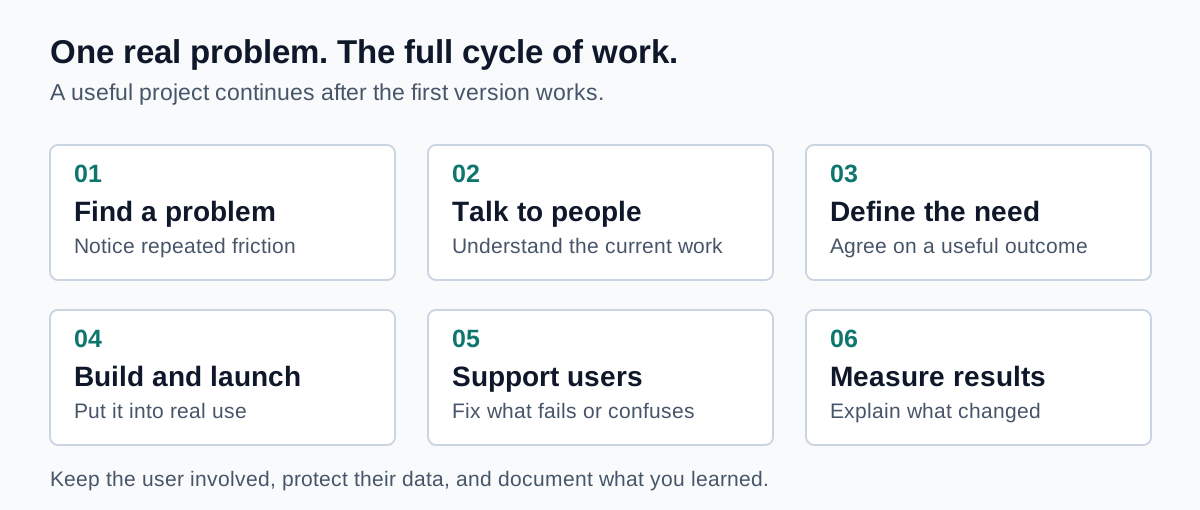
*Taking a solution into real use and supporting it is where much of the learning happens.*
- Weeks 1–2: Find and define the problem. Read junior job descriptions to understand the work in your target field. Look around a college, local business, community group, or workplace for a repeated frustration. Talk to the people who experience it. Ask what they do today, what it costs them, and what a useful improvement would look like. Agree on a small problem you can actually address.
- Weeks 3–6: Build a solution with them. Show an early version, listen, and revise. In software, that might be an application or automation with tests and basic security; in another field, it might be a service improvement, analysis, repair process, or practical design. Keep track of your assumptions, decisions, and the work you personally did.
- Weeks 7–8: Put it into real use. Deploy it or introduce the new process with the user's permission. Help people start using it. Watch what breaks or confuses them, fix the important problems, and take responsibility for support. Respect privacy, safety, and any professional rules that apply to the work.
- Weeks 9–12: Measure, explain, and apply. Find out whether the solution saved time, reduced errors, or helped in another observable way. Write a short case study covering the original problem, conversations, tradeoffs, launch, failures, support, and results. Use that evidence in targeted applications and interviews; keep improving the solution while you search.
Working with a real user, a live problem, and the responsibility of supporting your work can teach lessons that an isolated tutorial cannot. You will also have a stronger interview story: what you noticed, how you understood the need, what you built, what happened after launch, and what you changed. Twelve weeks will not erase structural hiring problems or guarantee an offer, but it can replace vague preparation with observable progress.
What parents and colleges can do
Parents can ask better questions without needing to become software engineers: What did you build? Who used it? What did you learn when it failed? What are recent graduates from this particular college doing? How much debt are we taking on, and what is our fallback plan if placement takes a year?
Colleges should publish honest cohort outcomes, bring recent alumni into career discussions, and make internships and real projects easier to access. If a program advertises a career path, it owes students evidence about that path. A single placement percentage without the denominator, role mix, joining status, and pay distribution is not enough.
The software profession is still creating work, and other fields offer worthwhile paths. But the entry ticket is changing. For a fresher, the safest bet is neither blind faith in the old campus pipeline nor fear of AI. It is a combination of fundamentals, demonstrated work, responsible use of new tools, current market information, and a financial plan that does not depend on a guaranteed offer.
That is a harder message than “take this course and get hired.” It is also a more honest one.
Sources and scope
- Ministry of Education, AISHE Final Report 2023–24, Table 36: Engineering & Technology undergraduate pass-outs. The survey reports institutional education data, not employment outcomes.
- Nasscom, Strategic Review FY2025 press release: estimated net workforce addition and total technology workforce. Net addition is not graduate intake.
- World Economic Forum, Future of Jobs Report 2025: global employer expectations for roles and skills, not an India fresher hiring forecast.
- Anthropic Economic Index, AI's impact on software development: product usage study from April 2025, not a measure of job displacement.
- TCS and Infosys annual reports and company statements linked in the five-year timeline, plus the HCLTech FY2025 investor release: company-defined fresher intake, with different geographic scopes and definitions.
- World Economic Forum, Future of Jobs 2025 press release, National Career Service FAQs, and India Economic Survey employment and skill-development chapter: sources for the broader career framework and public career resources.